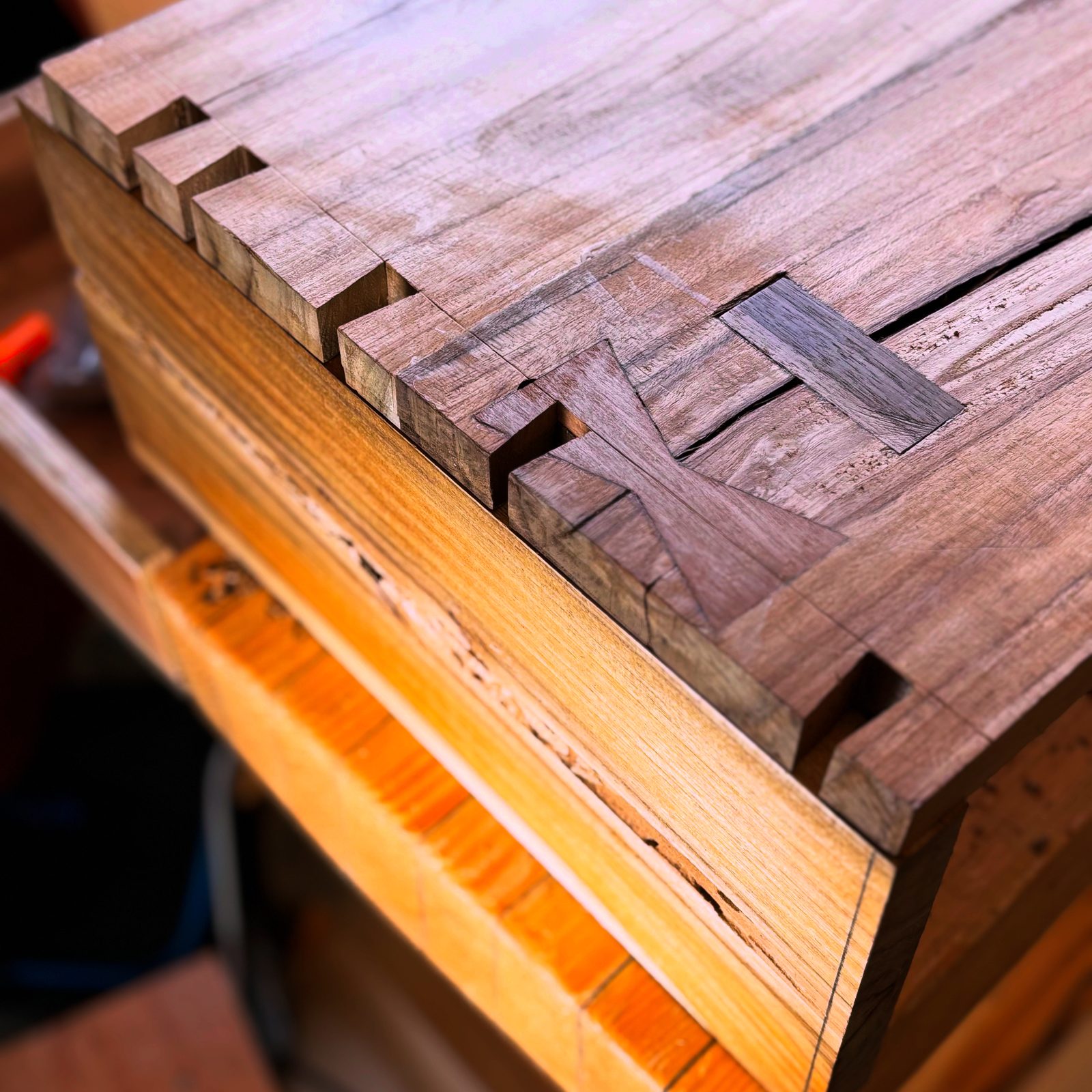
Hand cut dovetail joinery detail
Hand tool woodworking · Dubai

Wood shaped
by hand,
read by grain

Joinery  ·  Commissioned furniture  ·  Levantine craft

Selected work
Live edge walnut table
Live edge table · Walnut
Stick arm chair in ash
Stick arm chair · Ash
Oak sideboard commission
Sideboard · Oak & brass
Bar cabinet with joinery
Bar cabinet · Oak
Live edge desk
Live edge desk · Mixed hardwood

Made slowly,
with intention

Commissioned furniture and joinery work made by hand in Dubai. No machines where hands will do. Each piece shaped with chisels, saws and planes — the same tools used for centuries across the Levant.

The wood decides. Grain direction, figure, character — these dictate how a piece is built, not the other way around.

Simple bench in natural wood
Tools I use & trust
Lie-Nielsen chisels
For clean dovetail walls and paring to the line. A2 steel holds an edge longer than anything else I've used.
View on Amazon →
Japanese pull saw
Rip and crosscut with control. Cuts on the pull stroke — far more accurate for joinery than western saws.
View on Amazon →
Veritas marking gauge
Consistent baselines every time. The wheel cutter scores cleanly across and with the grain.
View on Amazon →
Card scraper
Essential for finishing olive and walnut without tearout. No sandpaper needed after a well-tuned scraper.
View on Amazon →
From the journal
Dovetail joinery process
Hand tools
The chisels I reach for on every dovetail
After years of commissioned work in Dubai, three chisels have earned permanent spots on my bench. Here's what they are, why they stay, and where to get them.
Read more →
Dovetail box in progress
Process
Hand cutting a dovetail box from scratch
No jigs, no router, no shortcuts. Just a saw, a chisel and a marking gauge. Here is how a simple box taught me everything about reading wood.
Read more →
← Back to journal
Hand tools

The chisels I reach for
on every dovetail

Levant & Grain  ·  Dubai  ·  June 2026  ·  6 min read
Hand cut dovetail detail

I have owned a lot of chisels. Some came recommended, some came cheap, and a few came with serious price tags that I questioned every time I reached past them for something else. After years of commissioned work — stick chairs, dovetail boxes, live edge furniture built by hand in Dubai — the bench has sorted itself out. Three chisels remain.

Why the chisel matters more than the technique

A dovetail cut with a dull or poorly ground chisel is a dovetail cut twice. You pare to the line, the edge rolls, you go again. With the right tool, you pare once. The wall is vertical, the fit is tight, and you move on. The chisel is not incidental to the process — it is the process.

I learned this the hard way on my first commissioned box. The joinery looked right in pencil. By the time I'd finished paring the tails with a cheap bench chisel, the gaps told the whole story.

The three that stay

The first is a set of Lie-Nielsen bench chisels in A2 tool steel. These are not cheap. They are also not negotiable for fine joinery. The A2 steel holds an edge longer than O1 in my experience — particularly on the end grain work that dovetails demand. The handles are comfortable for hours of work and the blades arrive flat enough to use after minimal lapping.

Used in this post
Lie-Nielsen Bench Chisels — A2 Tool Steel
Find on Amazon →

The second is a Narex premium mortise chisel for the heavier chopping work — clearing waste between tails before the final paring. The Narex punches well above its price. Czech steel, good geometry, and a handle that takes mallet blows without complaint.

Used in this post
Narex Premium Mortise Chisel Set
Find on Amazon →

The third is a narrow Japanese paring chisel — a 3mm Tasai — for getting into the tight corners of half-blind dovetails and cleaning up the baseline. There is no western equivalent that works as well in that application. The laminated steel takes a finer edge than anything else in the rack.

The wood does not care what the chisel costs. It cares how sharp it is.

How I keep them sharp

A sharp chisel used on a dull edge is not a sharp chisel. I sharpen on water stones — a 1000 grit for re-establishing the bevel and a 6000 grit for the final edge. The Shapton Glass stones are what I use and trust. They cut fast, they flatten easily, and they last.

Also recommended
Shapton Glass Stone Set — 1000 & 6000 grit
Find on Amazon →

The test is simple. After sharpening, the edge should shave arm hair cleanly and pare end grain without catching. If either fails, go back to the stones.

The bottom line

You do not need all three to start. If I had to pick one set for a beginner cutting their first dovetails, it would be the Narex premium bench chisels — good steel, honest price, and they will outlast most of what sits at the same price point. Upgrade to Lie-Nielsen when the work demands it. You will know when that is.

← Back to journal
Process

Hand cutting a dovetail
box from scratch

Levant & Grain  ·  Dubai  ·  May 2026  ·  8 min read
Dovetail box in progress

The dovetail box is where hand tool woodworking begins and, in many ways, where it never ends. Every experienced maker I respect still cuts them. Not because they have to — because a tight hand-cut dovetail is the most honest measure of whether you truly understand wood, tools, and the relationship between the two.

This is how I build one. No jigs. No router. No shortcuts.

The wood

For a first box, choose something forgiving. Cherry is ideal — it cuts cleanly, shows the joinery clearly, and finishes beautifully. I have built boxes in olive wood from the Levant and the results are stunning, but olive is dense and unpredictable and will punish a dull tool instantly. Learn on cherry. Move to olive when you are ready.

Marking out the tails

I use a Veritas wheel marking gauge to scribe the baseline — set to the exact thickness of the mating board. The wheel cutter scores a fine line across and with the grain without tearing. This baseline is everything. Every cut you make is relative to it.

Tool used
Veritas Wheel Marking Gauge
Find on Amazon →

The tails are marked with a sliding bevel set to a ratio of 1:8 for softwood, 1:6 for hardwood. I mark directly on the end grain with a sharp marking knife — not a pencil. A pencil line has width. A knife line has none. That difference matters when you are fitting to within a fraction of a millimetre.

Sawing

I saw the tails with a Japanese Gyokucho pull saw — the 240mm Ryoba with both rip and crosscut teeth. The pull stroke gives me far more control than a western saw on this work. I saw just to the waste side of the knife line, keeping the blade vertical by watching the reflection in the polished side of the blade.

Tool used
Gyokucho Ryoba Pull Saw 240mm
Find on Amazon →

Chopping and paring

Waste between the tails comes out in two stages. First a mallet chop halfway through from one face, then a chop from the other to free the waste. Then paring to the baseline with a sharp chisel held vertically. The goal is a wall that is perfectly perpendicular to the face and sits precisely on the scribed line.

Do not sneak up on the line. Go to it. A confident cut leaves a cleaner surface than ten tentative ones.

Fitting

The pins are marked directly from the tails — no measuring, no transferring dimensions. The tails sit on the end of the pin board, a marking knife traces each tail exactly, and those knife lines become the saw lines. This is the only reliable way to get a tight fit.

The first test fit should be tight. Too tight to go together by hand is correct — the final mallet taps will close any remaining gap. If it goes together easily by hand, there is slop in the joint.

The finish

I finish dovetail boxes with a single coat of Danish oil followed by paste wax. The oil feeds the wood and brings out the grain. The wax protects and gives a soft sheen that a varnish never quite matches on hand-worked surfaces.

Finish used
Watco Danish Oil — Natural
Find on Amazon →

The box in the photograph above was my third commission. The wood is Lebanese cedar — dense, aromatic, and deeply personal to build with. It sits on someone's desk in Dubai. The joinery will outlast us both.